No Results Found.
The page you requested could not be found. Try refining your search, or use the navigation above to locate the post.
The page you requested could not be found. Try refining your search, or use the navigation above to locate the post.

Many people living with Lipedema spend years trying to understand what is happening to their body.
One of the biggest challenges is that Lipedema is often confused with obesity or lymphedema, even though these are very different conditions.
Because the symptoms can overlap in some ways, it can be difficult to know which condition may be responsible for swelling, fat accumulation, or changes in body shape.
Understanding the differences between Lipedema, obesity, and lymphedema can help people recognize patterns earlier and begin seeking appropriate medical guidance.
What Is Lipedema?
Lipedema is a chronic disorder of fat distribution that primarily affects women.
It causes abnormal accumulation of fibrotic fat tissue, most commonly in the:
• hips
• thighs
• legs
• buttocks
• sometimes the arms and torso
Unlike typical body fat, Lipedema tissue often develops symmetrically on both sides of the body and may feel painful, tender, or heavy.
Key characteristics of Lipedema often include:
• fat that does not respond normally to diet or exercise
• symmetrical fat accumulation in limbs
• easy bruising
• heaviness or tenderness in affected areas
• swelling that can worsen over time
In later stages, Lipedema can also increase the risk of secondary lymphedema when lymphatic drainage becomes compromised.
What Is Obesity?
Obesity is a metabolic condition involving excess body fat throughout the body, typically caused by a combination of factors such as energy balance, hormones, genetics, and lifestyle.
Unlike Lipedema, obesity usually presents with generalized weight gain, meaning fat accumulates across many areas of the body rather than specific patterns.
Common characteristics of obesity include:
• fat distributed across the entire body
• weight gain that may respond to diet and exercise
• metabolic factors such as insulin resistance
• increased risk of conditions like diabetes and heart disease
While Lipedema and obesity can occur together, they are not the same condition.
Many women with Lipedema maintain healthy diets and active lifestyles yet still experience disproportionate fat accumulation.
What Is Lymphedema?
Lymphedema is a condition caused by impaired lymphatic drainage, leading to fluid buildup and swelling in the body.
It often affects:
• arms
• legs
• hands
• feet
Unlike Lipedema, lymphedema swelling is usually caused by fluid accumulation rather than fat tissue.
Lymphedema may develop after:
• surgery or lymph node removal
• radiation therapy
• injury or infection
• congenital lymphatic abnormalities
Over time, untreated lymphedema can lead to tissue thickening and changes in the skin.
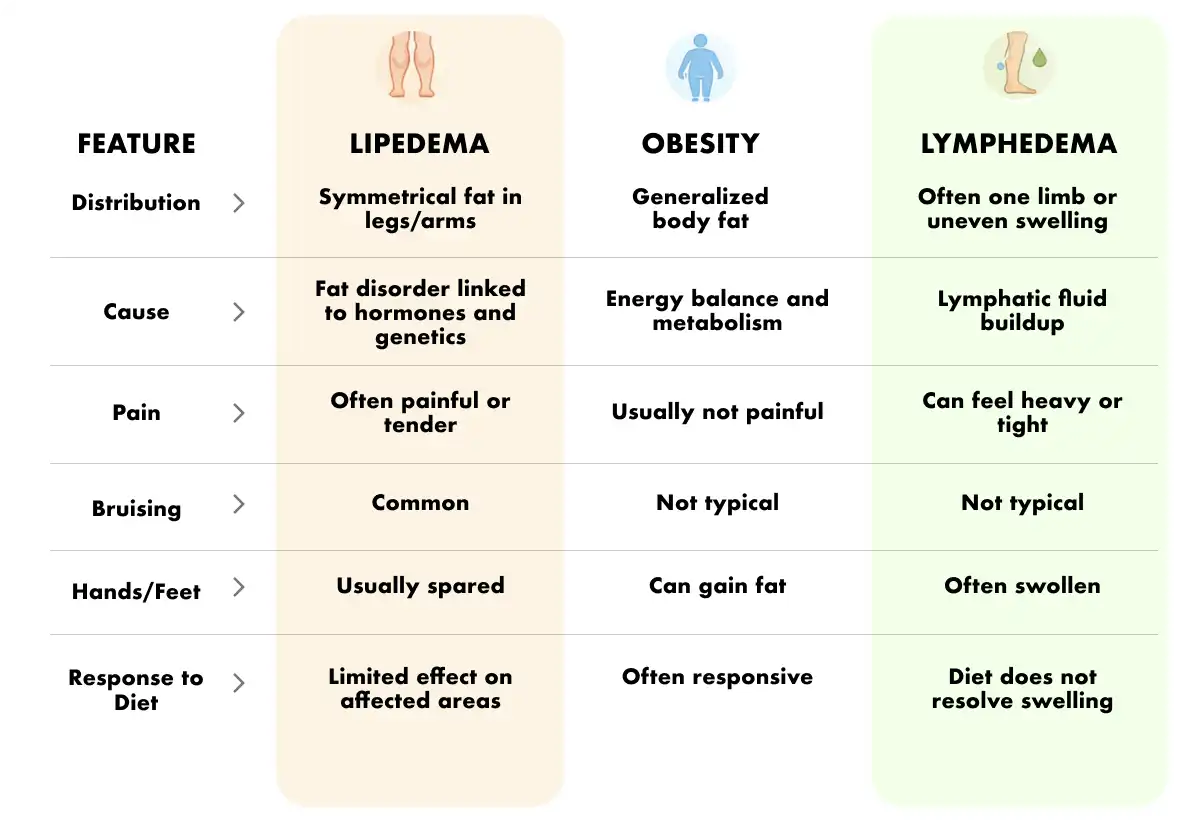
Key Differences Between the Conditions
While these conditions can sometimes appear similar, several characteristics help differentiate them.
Why Misdiagnosis Happens
Lipedema is still under-recognized in many areas of medicine, which means many patients are initially told their symptoms are related to weight gain or lifestyle.
Because the condition develops gradually and often appears during hormonal transitions—such as puberty, pregnancy, or menopause—it can easily be mistaken for other causes.
Many people spend years trying different diets, exercise programs, and treatments before receiving the correct diagnosis.
Awareness is improving, but education remains one of the most important tools for early recognition.
When Lipedema and Lymphedema Occur Together
In more advanced stages of Lipedema, the lymphatic system can become overwhelmed.
When this happens, patients may develop Lipo-Lymphedema, a condition where Lipedema fat accumulation is combined with lymphatic fluid retention.
This is why early awareness and appropriate care strategies can be important in helping manage progression.
Understanding Your Symptoms
If you are experiencing unexplained changes in fat distribution, swelling, or persistent heaviness in your limbs, it may be helpful to speak with a healthcare professional familiar with Lipedema and lymphatic conditions.
Education and awareness can help patients better understand their bodies and explore appropriate care options.
Go deeper

All
If you've spent years being told to simply eat less and move more while your lower body stays stubbornly disproportionate […] Read more
The page you requested could not be found. Try refining your search, or use the navigation above to locate the post.
· Aug 26, 2026

News
Physicians continued discussing evolving standards of care. Patients shared personal stories and treatment experiences. Sponsors, clinicians, and wellness partners answered questions while new connections formed between people who, only hours earlier, had been strangers. It was perhaps the clearest sign that the 2026 Lipedema Summit Live Event had achieved its purpose. Held on June 11, 2026, in Downtown Los Angeles, the event brought together patients, clinicians, surgeons, researchers, therapists, advocates, caregivers, and industry partners for an evening centered on education, awareness, and connection. While the virtual Lipedema Summit was designed to reach thousands of people around the world, the live event created something equally valuable: the opportunity for meaningful conversations to happen face-to-face. Throughout the evening, attendees engaged directly with leading experts, explored emerging research, discussed treatment approaches, and exchanged experiences with others navigating similar challenges. Conversations ranged from evolving standards of care and surgical outcomes to conservative therapies, patient advocacy, and the future of Lipedema research. For many attendees, the event offered something difficult to find elsewhere: direct access to experts, honest conversations, and the opportunity to connect with others who truly understand the realities of living with Lipedema. Long after the final panel concluded, those conversations continued, reflecting both the growing momentum within the Lipedema community and the shared commitment to advancing awareness, education, and patient care.
The page you requested could not be found. Try refining your search, or use the navigation above to locate the post.
· Jun 21, 2026

Sponsor Feature
When most people think about Lipedema, they think about abnormal fat accumulation. They think about disproportionately larger legs, pain, tenderness, easy bruising, and the frustration of trying countless diets and exercise programs without seeing meaningful changes.
The page you requested could not be found. Try refining your search, or use the navigation above to locate the post.
· Jun 1, 2026

Sponsor Feature
For many women living with Lipedema, finding a surgeon is only part of the challenge. Finding a team that truly understands the disease is often much harder.
The page you requested could not be found. Try refining your search, or use the navigation above to locate the post.
· Jun 1, 2026

Sponsor Feature
For many women diagnosed with Lipedema, the healthcare journey can feel fragmented.
The page you requested could not be found. Try refining your search, or use the navigation above to locate the post.
· Jun 1, 2026

Sponsor Feature
GLP 1 medications have changed the conversation around obesity, metabolic health, inflammation, and chronic disease. For many patients, they have opened doors that previously felt out of reach. Yet as these medications become more widely available, a new challenge has emerged: access does not always equal quality care.
The page you requested could not be found. Try refining your search, or use the navigation above to locate the post.
· Jun 1, 2026

Sponsor Feature
Most Lipedema patients eventually learn that compression is one of the most important parts of conservative care.
The page you requested could not be found. Try refining your search, or use the navigation above to locate the post.
· Jun 1, 2026

Summit Info
The 2026 Lipedema Summit brings together an extraordinary lineup of surgeons, physicians, researchers, therapists, advocates, and patients for three days of conversations focused on diagnosis, treatment, recovery, long-term management, and the future of lipedema care.
The page you requested could not be found. Try refining your search, or use the navigation above to locate the post.
· May 25, 2026

Education
Lipedema is often discussed as a physical condition, one that affects fat distribution, lymphatic health, and metabolic function. But for the millions of women living with Lipedema, the emotional wounds can run just as deep as the physical ones. The reflection in the mirror that no longer feels like you. The constant comparisons. The judgment from strangers, doctors, and sometimes even the people closest to you. These experiences leave marks that go far beyond the body.
The page you requested could not be found. Try refining your search, or use the navigation above to locate the post.
· Mar 15, 2026

Education
Lipedema is a chronic medical condition that affects the way fat is distributed in the body. It most commonly appears in the legs, hips, and sometimes the arms, while the hands and feet are typically unaffected.
The page you requested could not be found. Try refining your search, or use the navigation above to locate the post.
· Mar 13, 2026
Sign in to access your summit libraries, saved sessions, and progress.